 SmartHarmony AI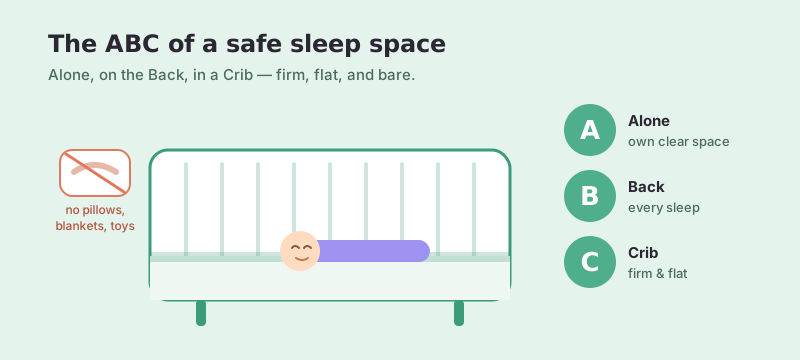
- Alone, on the Back, in a Crib or bassinet — for every sleep.
- A firm, flat surface with a fitted sheet and nothing else in it.
- Comfortably cool beats warm; dress for the room, not the season.
- The same rules apply to naps as to nights.
Safe-sleep practices are backed by pediatric health authorities and are among the few areas where the guidance is deliberately firm and consistent. The reason is simple: the setup that keeps a baby safest is easy to describe, easy to repeat, and easy to get right once you know it. Nothing here replaces your healthcare professional — homes, health histories, and circumstances vary, and anything specific to your baby or your setup is exactly the kind of question to bring to them.
The simple ABCs
A widely used shorthand captures the essentials in three letters: babies sleep safest Alone — in their own clear space, never sharing a sleep surface with an adult, a sibling, or a pet — on their Back for every single sleep, day and night, and in a Crib or bassinet built for the purpose and meeting current safety standards. None of these is a preference or a nicety; each one removes a specific hazard, and together they form the baseline that everything else builds on.
Back-sleeping deserves a note of its own, because it's the part parents most often second-guess. Place your baby on the back for every sleep until they are rolling both ways reliably and on their own. Once a baby can roll confidently in both directions, you don't need to keep repositioning them through the night — but you still always place them down on the back. Side-sleeping and stomach-sleeping are not safe alternatives for placing a baby down, and a baby who has recently learned to roll but tires quickly may still need close attention.
The sleep surface and space
The surface should be firm and flat, fitted with a snug crib sheet and nothing else. That means no pillows, no crib bumpers (padded or mesh), no loose blankets, no soft or stuffed toys, and no positioners, wedges, or props of any kind. A soft, saggy, or inclined surface, or an object that can shift against a baby's face, is precisely what a bare setup is designed to remove. If your baby needs warmth, a correctly sized sleep sack or wearable blanket does the job of a blanket without any loose fabric near the face.
The fit of the sleep space matters as much as what's in it. The mattress should match the frame so there are no gaps at the edges where a limb or head could become wedged, and the mattress should be the firm one the product was sold with, not a softer replacement. Hand-me-down and second-hand equipment can be wonderful, but check that a crib or bassinet hasn't been recalled, isn't missing parts, and still meets current standards before you use it. A bare, well-fitted space isn't a minimalist aesthetic — it's the single most reliable thing you control.
Temperature and environment
Comfortably cool beats warm. Overheating is a genuine risk, so dress your baby for the temperature of the room rather than the season on the calendar — a useful rule of thumb is roughly one more light layer than an adult would be comfortable in. Skip hats indoors for sleep, since babies release a lot of heat through the head, and check for signs of being too warm: sweating, damp hair, flushed skin, or a hot chest or back of the neck. If in doubt, remove a layer rather than add one.
The wider environment counts too. Keep the sleep space completely smoke-free, before and after birth, as smoke exposure is a well-established risk. Position the crib away from windows, blind and curtain cords, and anything hanging that could be pulled or reached, and keep monitor cords and other cables well clear of where a baby can grasp them. A quiet, dark, cool room supports settling, but the safety essentials — a clear surface and an unobstructed space — come first and never bend for comfort.
Naps count too
Every one of these rules applies to every sleep, not only the long stretch overnight. It's easy to relax the setup for a quick daytime nap, but the safest habit is the consistent one: the same firm, flat, bare space for naps as for nights. Consistency also helps a baby learn where sleep happens, which tends to make settling easier over time.
Car seats, swings, bouncers, slings, and carriers all have their place during waking hours, but they are not designed for unsupervised or routine sleep, because a baby's position in them can let the chin drop toward the chest and restrict breathing. If your baby falls asleep in one — and they will — the goal is to move them to their flat sleep space as soon as you safely can, and to keep an eye on them until you do. When you're travelling and a car seat is genuinely necessary, keep the trip as short as practical and check on your baby often.
Room-sharing and everyday realities
Sharing a room — with your baby in their own crib or bassinet placed near your bed — is widely recommended for the early months and is quite different from sharing a surface. Room-sharing keeps your baby close for feeding and comfort while preserving the separate, clear sleep space that keeps them safest. It's a distinction worth holding onto, because the two are easy to blur when you're exhausted at three in the morning.
Real life doesn't always follow a diagram, and it helps to plan for the moments when it won't. Night feeds happen; if you feed in your own bed, the safer approach is to keep the adult bed clear of pillows, duvets, and soft bedding, to stay awake, and to return your baby to their own flat space to sleep once the feed is done. Because family circumstances — sleep arrangements, feeding choices, health histories — vary so widely, your healthcare professional is the right person to talk through your specific setup, any equipment you're unsure about, and any question this guide can't answer for your situation.
General guidance, for information only — not a substitute for professional medical advice. When in doubt, contact your healthcare professional.