 SmartHarmony AI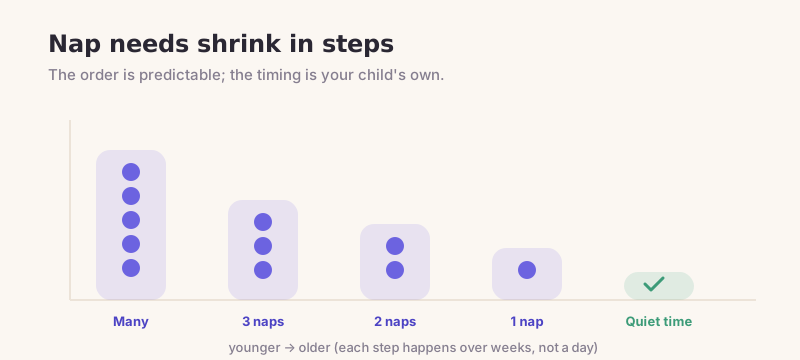
- Total daytime sleep slowly falls and consolidates over the first few years — fewer, longer, better-timed naps.
- The order of transitions is predictable; the timing is very individual, and a wide range is normal.
- Look for a real pattern over a week or two — not one odd day — before you drop a nap for good.
- An earlier bedtime is your steadiest tool through every transition.
Why nap needs shrink
Over the first few years, your child's total daytime sleep gradually falls and, just as importantly, consolidates. A newborn sleeps in many short, scattered bursts around the clock because their body clock and sleep pressure system are still immature — they simply can't hold a long stretch awake or a long stretch asleep. As the brain matures, sleep organises itself: the many bursts merge into a handful of naps, then into two, then into a single afternoon nap, and eventually into none at all. Each step down is a sign of development, not decline — your child is growing into a more grown-up sleep pattern.
The engine behind this is a slow rise in how long your child can comfortably stay awake. Awake time builds up "sleep pressure," the natural drive to sleep; when that pressure is low, a nap that once worked will start to fall apart. So a dropped nap usually isn't a problem to fix — it's a threshold your child has crossed. The catch is that day sleep and night sleep are linked: when a nap disappears before the body has fully adjusted, that missing sleep doesn't vanish, it simply shifts. That's why so many nap transitions show up first as choppier nights or earlier mornings rather than as an obvious daytime change.
Signs a transition is coming
Transitions rarely announce themselves politely, and they almost never happen overnight. Instead you'll notice a cluster of small changes that don't add up to your usual routine. The single most useful habit is to judge the pattern over a week or two rather than reacting to any single hard day — one bad nap tells you very little, but the same struggle repeating most days is real information. Common early signals include:
- Consistently fighting or flat-out refusing a nap that used to go down smoothly.
- Taking a long time to fall asleep at nap time, bedtime, or both.
- Early-morning wakings or a generally shorter, more broken night.
- A nap that, once taken, pushes bedtime uncomfortably late.
It helps to notice where the pressure is showing up, because that points to the fix. If the last nap of the day is the one being refused, or it's the nap that keeps shoving bedtime later, that's often the nap on its way out. If instead your child settles fine but keeps waking before dawn, they may be getting slightly too much day sleep for their age. Reading which piece of the day is straining tells you whether to trim a nap, shorten one, or simply hold steady and wait a little longer before changing anything.
Teething, a cold, travel, a growth spurt, or a developmental leap can all masquerade as a nap transition. Give it a week or two of a genuinely consistent new pattern before you drop a nap for good — dropping a nap too soon usually backfires into overtiredness, which then wrecks the very nights you were trying to protect.
The common transition points
While the timing is very individual, the order of transitions is remarkably predictable: many naps → three naps → two naps → one nap → no naps. Every child walks down this same staircase (see Figure 1); they just do it at their own pace. Some reach each step noticeably earlier and some noticeably later, and a wide spread is entirely normal — it's driven by an individual child's biology, not by anything you did or didn't do. The most useful comparison is never to another baby, or to a chart, but to your own child's pattern a few weeks ago.
Not all steps are created equal. The earliest transitions tend to be gentle, because the awake windows involved are still short and forgiving. The bumpiest are usually the move to a single nap and, later, the drop of naps altogether — precisely because they stretch the awake time the most, leaving the least margin before overtiredness sets in. Around those two transitions in particular, expect a longer, messier adjustment and lean hard on the tools below rather than expecting a clean overnight switch.
Easing the change
The friendliest, most reliable tool during any transition is an earlier bedtime. As day sleep drops, your child accumulates a small amount of sleep debt while their body adapts; an earlier night quietly repays that debt and prevents the overtired spiral that makes settling harder. It feels counter-intuitive — less day sleep, yet you move bedtime earlier, not later — but overtiredness, not undertiredness, is what usually derails a transition. Treat an earlier bedtime as your default response to almost any wobble during this period.
Beyond that, the guiding principle is to change things gradually and to expect an untidy middle stretch where good days and hard days alternate. A few practical pointers:
- Move gradually — shift naps and bedtime by 15–30 minutes at a time rather than all at once, giving the body clock room to catch up.
- Expect a messy middle: some days will feel like the old pattern, some like the new one, and that back-and-forth is the transition working itself out.
- On days a nap collapses entirely, bring bedtime forward — sometimes substantially — to head off overtiredness before it takes hold.
- Protect the remaining nap(s): a well-timed nap in a calm, dim space makes the whole day, and the following night, noticeably easier.
Transition, or just a rough patch?
The hardest part of any change is telling a true transition apart from a passing disruption, because in the moment they look identical. The clearest signal is time. If disrupted sleep lines up with a new skill your child is practising — rolling, crawling, pulling to stand — or with a cold, a trip, or a burst of teething, and it settles within a couple of weeks, it was almost certainly a temporary regression rather than a permanent shift. In that case the old nap schedule can and usually should return; you don't need to drop anything.
If, on the other hand, the new and shorter pattern holds steady for two weeks or more with no obvious illness or leap driving it, you're likely looking at a genuine transition to fewer naps, and it's worth gently reshaping the day to match. When you can't tell which is happening, there's no harm in waiting and watching a little longer — the pattern will usually declare itself. And if you're ever worried about your child's sleep, breathing, feeding, or general wellbeing, or something simply feels off to you, contact your healthcare professional, who can help you read what's going on.
General guidance, for information only — not a substitute for professional medical advice. When in doubt, contact your healthcare professional.