 SmartHarmony AI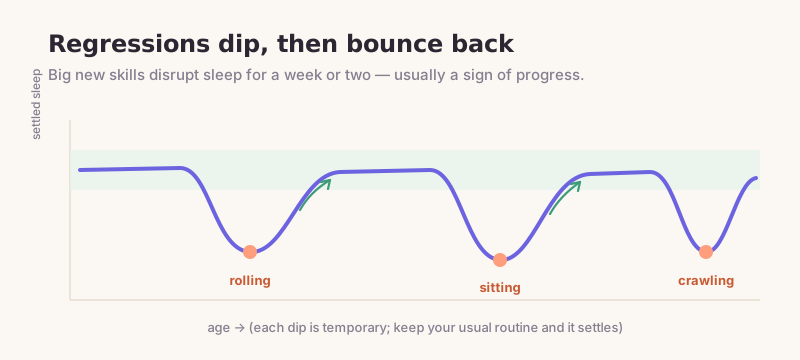
- A "regression" is usually a sign of progress — a new skill or leap disrupting sleep temporarily.
- Most settle within a couple of weeks; the disruption is a phase, not a permanent shift.
- Hold gently to your usual routine and protect daytime sleep — an overtired baby sleeps worse at night.
- Avoid inventing brand-new sleep crutches that outlast the rough patch and become the next problem.
What a regression really is
A "sleep regression" is a temporary stretch where a baby who was sleeping predictably suddenly wakes more, fights the settle, or takes short, unsatisfying naps. The name is a little unfair. The word regression implies going backwards, but what you're almost always watching is the opposite — a small step backwards in sleep because of a large step forwards somewhere else. The brain and body are busy building something new, and, for a week or two, sleep quietly pays the price for that construction work.
It helps to reframe it from "something has broken" to "something is being built". Sleep in the early years is not a fixed skill you master once and keep forever; it's a moving target that reorganises itself repeatedly as your baby grows. Each reorganisation can look, from the outside, like a loss of progress — a baby who used to link naps now catnaps, or one who slept through now surfaces at 3 a.m. In reality the underlying trend is upward, even when a given fortnight feels like nothing but interrupted nights. Naming the pattern is the first thing that makes it bearable: you are not undoing your work, and you have not caused this.
Why it happens
These stretches tend to cluster around bursts of development — learning to roll, sit, crawl, pull to stand, or a leap in language, memory, and awareness of the world. A baby practising a brand-new physical skill will often "rehearse" it at the worst possible hour: you'll find them up on hands and knees at 2 a.m., or rolling and then getting stuck and protesting. Their body is so keen to drill the new movement that it fires even in light sleep, nudging them awake. Cognitive leaps do the same thing from the inside — a newly busier, more curious brain simply has more to process, and processing tends to leak into the night.
Two other developmental shifts often sit underneath the most talked-about wobbles. One is a genuine change in how your baby sleeps: as the youngest babies mature, their sleep reorganises into more distinct, adult-like cycles, which means more moments where they surface between cycles and have to learn — again — how to drift back down on their own. The other is growing awareness that you exist even when you're out of sight, which can make separations at bedtime feel bigger and wakings feel lonelier. On top of all this, teething, illness, travel, and changes in daytime routine can layer on and blur the picture, so a "regression" is frequently several ordinary things arriving at once rather than one dramatic event.
What actually helps
There is no trick that ends a regression on command, because you're not fixing a fault — you're supporting your baby through a change that will pass on its own timeline. What genuinely helps is steadiness: keeping the familiar scaffolding in place so your baby has less to adjust to, and protecting the parts of the day that make nights easier. The aim is to ride it out with your baseline mostly intact, not to overhaul everything in week one.
- Hold gently to your usual routine — the same order of bath, feed, book, and bed is deeply reassuring when everything else feels unfamiliar to your baby.
- Protect daytime sleep; an overtired baby sleeps worse at night, not better, which quietly compounds the whole problem into a spiral.
- Give the new skill plenty of practice time during the day — floor time to roll, crawl, or pull up — so there's less left to rehearse at 2 a.m.
- Offer comfort freely and warmly; responding to a genuinely unsettled baby doesn't "spoil" sleep, and this stretch is short even when it doesn't feel that way.
- Consider a slightly earlier bedtime for a while to offset the extra night wakings and stop overtiredness building up across the week.
Give any single change a few nights before you judge it. Sleep is naturally noisy — one rough night in the middle of a recovery doesn't mean your approach has failed, and one good night in the middle of a hard patch doesn't mean it's over. Look at the trend across a week rather than reacting to each individual night, and change one thing at a time so you can actually tell what helped.
What not to overcorrect
The most common trap is introducing brand-new sleep crutches simply to survive the rough patch — starting an all-night feed-to-sleep habit, or an hour of rocking to get through the 3 a.m. wake — that then outlast the regression itself and quietly become the next thing you're trying to unwind. The regression would have passed in a fortnight either way; the new habit can stay for months. That's the real cost of over-reacting, and it's why the calmest path is usually the least dramatic one.
This is not an argument for withholding comfort — please comfort your baby as much as they need. The distinction is between comfort and tools. Comfort freely: soothe, hold, and respond. But try to keep the methods you use to get your baby to sleep roughly the same as before, so that when the leap passes, sleep can settle back to its previous baseline without a newly established crutch to dismantle. If you do lean on something extra to get through a hard week, treat it as temporary from the start, and gently step back from it as the wakings ease rather than letting it quietly become the new normal.
When to check in
The vast majority of disrupted sleep in the early years is developmental, self-limiting, and resolves without any intervention beyond patience and a steady routine. Knowing that is genuinely useful, because it lets you meet the broken nights with reassurance rather than alarm. Still, you know your baby better than anyone, and a regression is a pattern of sleep — not an explanation for every symptom — so it's worth staying alert to anything that feels different in kind, not just in degree.
If the disruption is severe, drags on much longer than a couple of weeks, arrives alongside other symptoms such as feeding changes, fever, or a baby who seems unwell or in pain, or if you're simply worried, your healthcare professional can help you think it through. Trust your instinct and reach out — you know your baby best, and asking is always reasonable.
General guidance, for information only — not a substitute for professional medical advice. When in doubt, contact your healthcare professional.