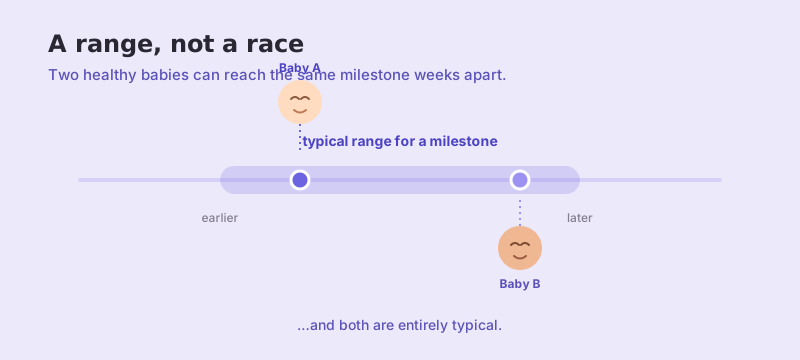
Development happens in a broad, overlapping range rather than on fixed dates. Milestones are best used as a gentle map of what tends to come next — not a scorecard, and not a source of comparison at the playground.
A range, not a race
Two perfectly healthy children can reach the same milestone weeks or even months apart and both be entirely typical. That's not a gap to close or a race to win — it's simply how growth works. When you look at a single "average" date, it's easy to forget that it sits in the middle of a wide, healthy spread on either side.
Milestones are most useful as a picture of what usually comes next, so you know roughly what to watch for and enjoy. They're least useful as a stopwatch or a comparison against another baby — the child in front of you is the only one whose rhythm matters here.
If your baby was born early, development is usually followed against their "corrected" age (adjusted for prematurity) for the first couple of years. Your pediatrician can explain what that means for your child.
How to support it, simply
You don't need flashcards or expensive toys. The everyday things do the heavy lifting: talking and reading through your day, supervised tummy time and floor play, naming feelings and objects, and — above all — following your child's lead in play. Responsive, warm interaction is the most powerful developmental input there is.
So much of it is ordinary and free: narrating what you're doing, pausing to let them "answer," and giving them safe space to reach, roll, and explore. The pressure to constantly enrich is the part you can safely let go of.
The different domains
Development isn't one line moving forward — it's several strands, each with its own pace. It helps to think of them separately:
- Motor — from head control to rolling, sitting, crawling, and walking.
- Language — cooing and babbling, understanding words, then first words and phrases.
- Social & emotional — smiling, attachment, stranger awareness, and big feelings.
- Cognitive — attention, cause-and-effect, and the famous love of peek-a-boo.
Children often surge in one domain while another quietly consolidates — a baby busy learning to walk may pause on new words for a while. That's normal juggling, not a problem, and the paused strand usually catches up once the busy one settles.
When to raise a worry
If your child loses a skill they had, or you have a specific worry about movement, hearing, vision, or communication, that's always worth raising with your pediatrician. Trusting your instinct is part of good care — you know your child best, and early conversations are always reasonable.
None of this is about diagnosing anything from a chart at home. It's about noticing, staying calm, and bringing a real question to a real professional, who can look at the whole picture with you.

We write calm, plain-language articles about the early years, held to the same standard as the app: we describe patterns, never diagnose, and point you to your healthcare professional for anything clinical.
General guidance, for information only — not a substitute for professional medical advice. When in doubt, contact your healthcare professional.